
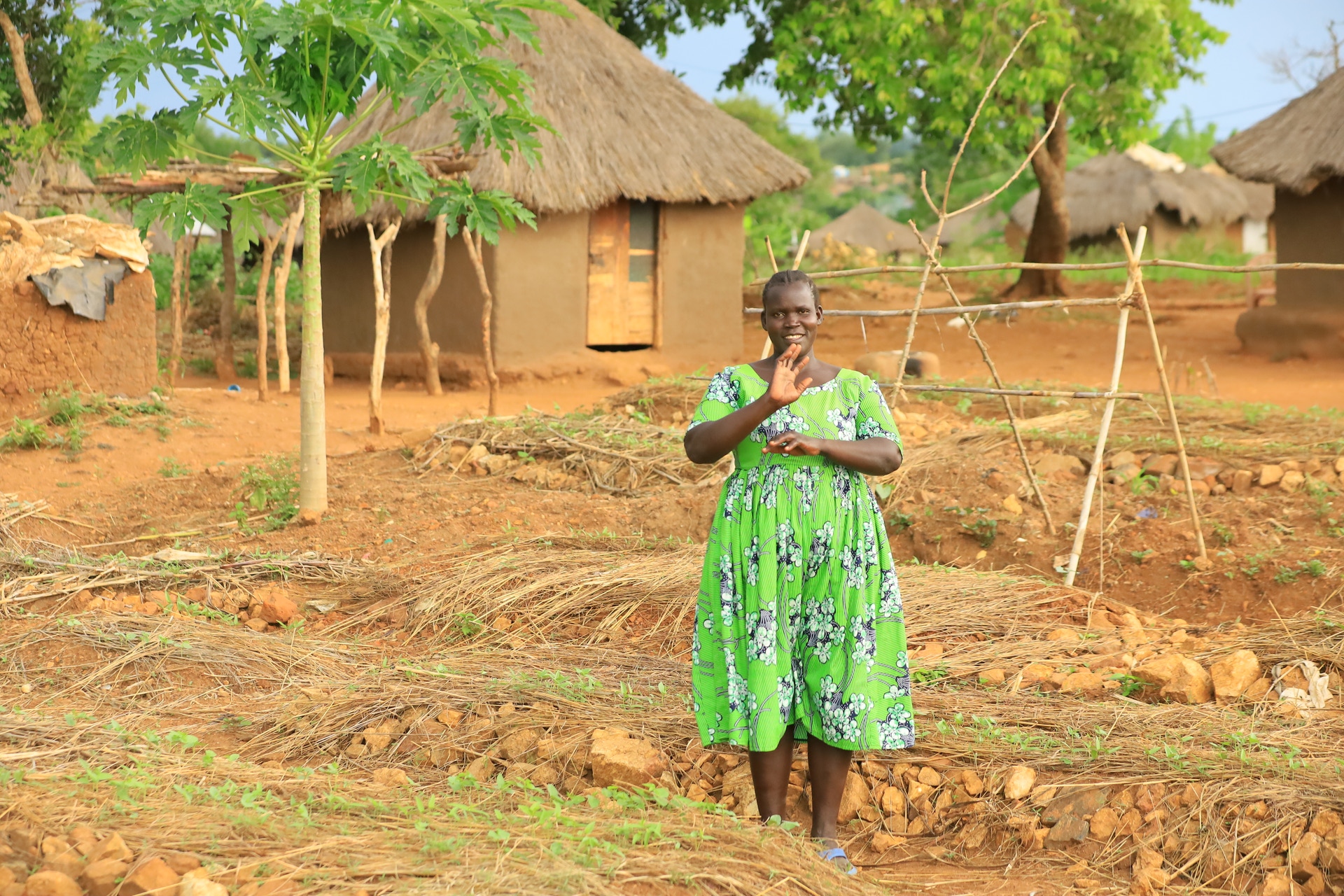
When heavy rains swept through Bidibidi Refugee Settlement Zone 2, they rarely brought relief.
Instead, water would pool heavily around Poni Patricia’s compound, eventually flooding the perimeter of her house, weakening the walls and foundation.
“We used to see the water just pass. It used to flood,” recalls Poni. For the 33-year-old mother of five, the downpours were just another source of anxiety in a life already weighed down by uncertainty.
Today, she watches the rain with a completely different perspective. Because now the water can run into her vegetable garden,
“I am happy with what they have done for me, channelling the water to be useful.”Poni – farmer and mother
Through training in so-called ‘Resilience Design’ Poni learnt something new. She discovered how to actively transform her environment. The runoff that once threatened her home is now intentionally channelled into a thriving backyard garden.
The training was part of the DANIDA-funded Uganda Refugee Resilience Initiative (URRI) and was carried out by the organisation Partners in Community Transformation (PICOT).
From a bare patch to a thriving garden
This simple yet profound shift in land management has given new purpose to her 30-by-30-meter settlement plot given by the Office of the Prime Minister (OPM). Once a bare patch offering little opportunity for food production, the land is now working for her. Applying the climate-smart techniques she learned, Poni has cultivated a diverse mix of sorghum, maize, amaranthus, and cowpeas.
“I have also learned something, like how to plant,” she notes, looking at her developing crops. “I have planted a lot. I expect a huge harvest.”
For a mother struggling as the sole provider for five children, that expectation carries immense weight.
“I have planted a lot. I expect a huge harvest,” says Poni.
Raising a family on her own
Poni arrived in Uganda in 2016 as a refugee with her family. However, in 2024, her husband returned to South Sudan to care for his ailing father, leaving her entirely responsible for the household’s survival.
She currently scrapes by on casual labour, earning about UGX 15,000 shillings (app. 3 EURO) when work is available. Nearly every coin goes toward food, leaving little for her children’s education. Her eldest son is in Primary 7, but raising school fees is a constant battle; some of her children have even had to miss their termly examinations.
“These are the challenges that I am facing, more especially if my children are not going to school,” she explains quietly. “It makes me think a lot.”
Poni hopes to reap where she sowed
Agriculture could be the lifeline she needs, but expanding beyond the settlement has proven risky. In the past, Poni hired land from the host community, only to face ownership disputes. Multiple people would claim the same land even after she had paid for its use, paralyzing her ability to farm with confidence.
She currently has cassava planted on host community land, but lives with the lingering fear that it could be taken away before harvest.
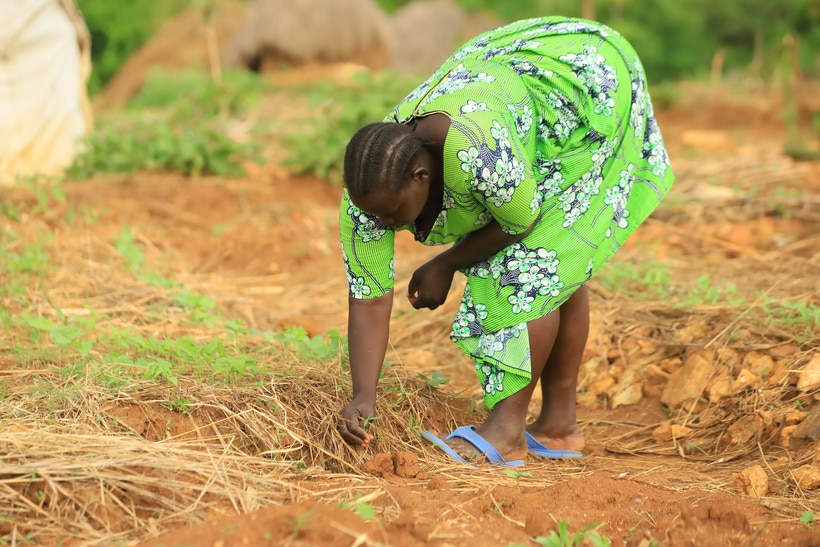
“It causes confusion and it is limiting my production level. It now brings trauma to me,” she says.
This uncertainty is exactly why the transformation of her own backyard matters so much. Rather than relying on distant, disputed land, Poni is maximizing the space she controls.
The resilience design approach introduced practical, accessible ways to work with her immediate natural environment – harnessing rainwater and optimizing crop placement.
No longer waiting for opportunities but investing in the future
While her garden is still growing and the ultimate harvest is yet to come, the very presence of these crops represents a fundamental shift in her daily life. She is no longer just waiting for casual labour or worrying about her family’s next meal. She is actively investing her energy into a secure, sustainable food source.
Challenges remain. Poni dreams of expanding her garden to include tomatoes and eggplants, but lacks the funds to purchase additional seeds.
Resilience yields many dividends
Yet, as she looks at the channelled water and the sprouting crops, her outlook remains fiercely optimistic. For Poni, resilience is not an abstract project indicator. It is the water safely redirected away from her doorstep. It is the soil she turned with her own hands.
And it is the profound hope that this small piece of land will soon yield more than just food – giving her family dignity, security, and a little more room to breathe.
Kadabara Boniface is the MEAL Manager at PICOT.
The Uganda Refugee Resilience Initiative (URRI)
URRI is a five-year (2024-2028) integrated program aimed at enhancing climate resilience and promoting inclusive development for 28,125 refugee and host community farmers in West Nile.
The intervention combines regenerative climate-smart agriculture, ecosystem restoration, and gender equality. Activities include establishing farmer field schools, supporting access to markets and finance, promoting sustainable land and water management, and empowering women and youth in decision-making.
