
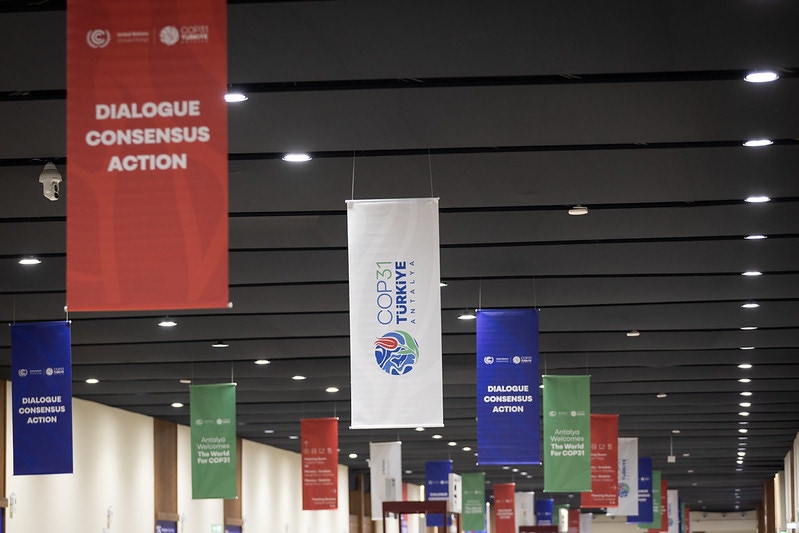
DanChurchAid warns that the failure to reach an agreement at the UN climate summit in Antalya undermines global climate action, but stresses that international cooperation is needed more than ever.
ANTALYA, TÜRKIYE, 22 November 2026 – The UN Climate Summit COP31 has ended without an overarching political agreement. After two weeks of difficult negotiations, governments have failed to deliver the progress needed to implement previous commitments on adaptation finance and transitioning away from fossil fuels.
DanChurchAid describes the outcome as a serious political failure, with consequences for millions of people already facing the impacts of climate change.
“I am deeply disappointed. World leaders came to COP31 knowing how serious the climate crisis is and what needs to be done. Yet they failed to find common solutions. This is a massive political failure, and the world’s most vulnerable people will pay the highest price,” says Mattias Söderberg, Global Climate Lead at DanChurchAid.
Climate impacts are accelerating, but political ambition is falling behind
The failure comes as recent research from the UN Environment Programme (UNEP) warns that global temperatures are expected to exceed 1.5°C above pre-industrial levels.
The magnitude and duration of this overshoot will determine how severe the consequences become. Rapid emissions reductions remain essential, alongside greater investments in adaptation and efforts to address loss and damage.
At COP30 in Brazil, governments agreed to triple international adaptation finance by 2035. At COP28 in Dubai, they agreed to transition away from fossil fuels in energy systems.
COP31 has failed to deliver the political progress needed to turn these commitments into concrete action.
“It is particularly disappointing that governments could not agree on how to deliver last year’s promise to triple adaptation finance. Vulnerable countries need real support, not another promise to continue discussions. We saw the devastating floods in Nepal in August, where lives were lost, homes destroyed and entire communities affected. The climate crisis is already here, and people cannot wait for another round of negotiations,” says Söderberg.
Political divisions must not destroy international cooperation
DanChurchAid is concerned that political divisions and resistance to stronger climate commitments have prevented progress.
Despite the urgent need to reduce emissions, some fossil fuel-producing countries continued to oppose stronger international language on transitioning away from fossil fuels.
At the same time, climate finance negotiations have been affected by declining development assistance budgets and disagreements over financial responsibilities.
“Some governments have spent more energy defending their national interests than finding solutions to a global crisis. Fossil fuel-producing countries that resist the transition must recognise that the world cannot continue relying on coal, oil and gas indefinitely. And wealthy countries must deliver on their financial commitments. Without stronger action on both emissions and finance, we will not be able to manage this crisis,” says Söderberg.
However, DanChurchAid stresses that the disappointing outcome should not become an argument for abandoning the UN climate negotiations.
“Climate change is a global crisis that demands global solutions. No country can solve it alone. We need international agreements, common goals and cooperation more than ever. The failure at COP31 is not a reason to give up on the UN process. It is a reason to strengthen our political commitment to making it work,” says Söderberg.
Positive initiatives show that international solidarity is still possible
Despite the failure of the formal negotiations, COP31 has also demonstrated that climate action continues.
Through the summit’s Action Agenda, governments, businesses, investors and civil society organisations have launched new initiatives and partnerships.
A group of countries announced plans to develop national roadmaps for transitioning away from fossil fuels, while several governments made new financial commitments to international climate funds.
One particularly notable example came from the Solomon Islands, one of the world’s most climate-vulnerable countries, which pledged USD 400,000 to the Green Climate Fund.
“The Solomon Islands has shown remarkable solidarity. Despite facing enormous climate challenges itself, this small island country has decided to contribute to international climate finance. It is a powerful reminder that cooperation and solidarity are still possible. These initiatives deserve recognition, but voluntary action cannot replace strong international agreements,” says Söderberg.
Media contact
Mattias Söderberg
Global Climate Lead, DanChurchAid
Email: msd@dca.dk
LinkedIn: Mattias Söderberg | LinkedIn
BlueSky: @matsod.bsky.social
X: @Mattias_S